A Large Delegation from the Latvian Academy of Culture Participates in the ACE²-EU Congress and Kaleidoscope Festival in Romania
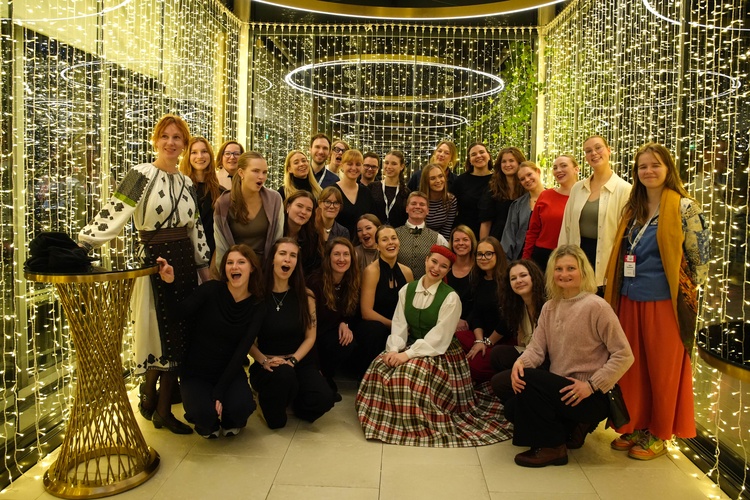
From 28 to 30 October 2026, the annual Congress of the ACE²-EU European University Alliance and the international cultural festival Kaleidoscope took place in Târgu Jiu, Romania. This year's events were hosted by Constantin Brâncuși University of Târgu Jiu (Universitatea „Constantin Brâncuși” din Târgu Jiu). The Latvian Academy of Culture (LAC) was represented by academic and administrative staff, students and external partners, who contributed to the Alliance's strategic development, participated in international educational programmes and engaged in cultural activities.
The second ACE²-EU Annual Congress, held under the theme From Formation to Impact and a Sustainable Future, brought together representatives from partner universities across nine European countries to review the Alliance's achievements and agree on priorities for its future development. The Congress focused on expanding international educational opportunities, strengthening cooperation between universities and society, engaging students and staff, and ensuring the Alliance's long-term sustainability.
The international cultural festival Kaleidoscope took place alongside the Congress under this year's theme, 100 Voices – One Future. The festival brought together students, lecturers and other representatives from partner universities, offering a diverse programme of creative workshops, cultural performances, discussions and intercultural activities. Emphasis was placed on cultural diversity, social well-being and the role of culture in shaping Europe's shared future.
LAC Vice-Rector for International Cooperation Agnese Hermane participated in the ACE²-EU Management Board meetings, where members reviewed the Alliance's progress, discussed future development directions and identified cooperation priorities. As one of the Alliance's nine partner universities, LAC actively contributes to joint initiatives, with a particular focus on the relationship between culture and society, international educational opportunities and cooperation with external stakeholders.
The ACE²-EU SPACE Centre team, led by Ieva Zemīte and Asnāte Kalēja, made a significant contribution to organising the Kaleidoscope festival, working closely with international partners to develop its concept and programme.
"The festival created a space where different cultures could meet and find a common language. It is precisely through such encounters, when people can come together in person, that genuine cooperation emerges. In today's fast-paced world, the festival offers an opportunity to spend time meaningfully while gaining a deeper understanding of Europe's rich cultural diversity," says Ieva Zemīte, reflecting on the significance of the festival.
LAC students also participated in the festival, joining young people from other European universities in creative workshops, intercultural activities and discussions. The festival programme provided opportunities to explore different cultural traditions and artistic expressions, collaborate in international teams and develop creative skills.
Together with representatives from other universities, LAC students actively contributed to the festival programme by participating in two specially designed activities. During the Student Innovation Lab, students from the master’s programme in Creative Industries and Growth Management – Ieva Īzāka-Harjo, Inese Kalniņa, Germans Reliņš and Una Filipoviča – introduced festival participants to one of Latvia's most significant cultural traditions, the Latvian Song and Dance Festival, and led a collective singing activity.
Meanwhile, during the International Cultural and Creativity Showcase, students from the Bachelor's subprogramme in Cultural Sociology and Management, Miks Lisovskis and Vendija Kokare, presented traditional Latvian dances and invited festival participants to join them in a collective dancing activity.
Students from the LAC National Film School also made a significant contribution to the festival programme by leading six international student teams in a short film production workshop. Over three days, the teams developed short films addressing issues relevant to Europe, including digitalisation, climate change, creativity and democracy. They completed the entire filmmaking process, from developing the initial concept to producing the final film. The short films premiered at the closing event of the Alliance Congress. Special thanks go to Audiovisual Arts students Kārlis Vladis Rudevičs, Anna Grundmane, Regīna Mūrniece, Elīna Folkmane, Odeta Ozoliņa and Henrijs Koleds for their contribution to the festival's short film programme.
Alongside the Congress and festival, four ACE²-EU microlearning programmes took place from 26 to 30 October, enabling students from partner universities to acquire new knowledge and practical skills while working in international teams. LAC students also participated in these programmes, enriching their studies through international cooperation and exposure to new approaches.
LAC lecturer Aija Lūse contributed to the organisation and delivery of one of these international learning programmes, Agritourism and Local Traditions, in cooperation with partner universities from Romania and Portugal. As part of the programme, she delivered a lecture entitled Telling the Local Story: Storytelling for Agritourism and Local Traditions, exploring the importance of local traditions, cultural heritage and community stories in creating meaningful tourism experiences. Drawing on examples of Romanian cultural heritage, including Polovragi Cave, local legends and the traditional ceramics of Horezu, participants were encouraged to consider how the history, people and traditions of a place can be transformed into engaging stories and authentic visitor experiences.
Film director Ieva Ozoliņa represented LAC at the ACE²-EU External Stakeholder Advisory Board meeting.
"Participating in the Congress gave me an opportunity to observe several important aspects up close. First, I realised just how valuable, yet challenging, it is to bring together representatives of such diverse cultures and professions and find a common rhythm. I also saw how important it is for our students to collaborate with students from other countries and step beyond the boundaries of their own disciplines.
Second, while experiencing the extensive cultural and thematic programme, I had the opportunity to visit the Rovinari lignite mining area (Bazinul Carbonifer Rovinari) near Târgu Jiu, where coal extraction is planned to be gradually phased out as part of the European Union's climate policy to reduce CO₂ emissions.
EU support programmes provide funding to ensure a just transition to a new economic reality. However, this also presents an enormous social challenge. What does it mean to ask a 60-year-old coal miner to retrain when he has spent his entire life working in the mines and there are not enough alternative jobs in his town? Yet change is necessary. Air pollution can be felt several kilometres away from the mines, posing a threat to both nature and human health. Without the involvement of the European Union, such changes would most likely happen very slowly, if at all," reflects Ieva Ozoliņa.
Marketing and Social Media Specialist Aija Melbārde represented the LAC on the ACE²-EU Staff Advisory Board. During the Board meetings, participants discussed staff involvement in the Alliance's development, professional development needs and international mobility opportunities. They also explored potential approaches to increasing the Alliance's visibility and encouraging broader participation among academic and administrative staff at partner universities.
Meanwhile, LAC was represented on the Student Advisory Board by students Annija Gardoviča and Agate Gaile, who joined representatives from other partner universities in discussions on student experiences, international mobility opportunities and the role of students in the Alliance's future development.
The discussions addressed current challenges in attracting students to the Alliance's programmes and opportunities for its future expansion. The outcomes were subsequently discussed with the Staff Advisory Board and presented at the Congress. Considerable time was also devoted to developing the Board's guidelines to make its work more effective and sustainable. Annija was elected Vice-Chair of the Student Advisory Board:
"I am grateful that the Board supported my candidacy and that the voice of our Academy's students will now be represented at a higher level within the Alliance. I hope that, together with the team, we will achieve everything we discussed during this week – and even more!" says Annija Gardoviča.
The ACE²-EU European University Alliance (Applied, Connected, Entrepreneurial and Engaged – European University) brings together nine higher education institutions from Latvia, Romania, Portugal, Lithuania, Poland, Austria, Spain, Germany and North Macedonia. The Alliance aims to develop an international, interdisciplinary and socially engaged higher education environment by promoting cooperation in education, research, innovation and community engagement.
Funded by the European Union. Views and opinions expressed are, however, those of the author(s) only and do not necessarily reflect those of the European Union or the European Education and Culture Executive Agency (EACEA). Neither the European Union nor EACEA can be held responsible for them. Project No. 101177596. The project is co-financed by the Ministry of Culture of the Republic of Latvia.