European university alliance ACE²-EU
News
LAC Representatives Seek Solutions for a More Inclusive and Respectful Society at International ACE²-EU Workshops
08.10.2026
From 28 to 30 September, Santarém Polytechnic University hosted the Knowledge Creation Team Workshops of the ACE²-EU European University Alliance, focusing on Social Well-Being and Respect & Dignity.
Students from Nine Countries Explore Gastronomic Cultural Heritage and Its Future in an International Programme
06.10.2026.
From 5 to 9 October, the Latvian Academy of Culture (LAC) in Riga is hosting the ACE²-EU European University Alliance microlearning programme “Taste of Culture: Cultural Heritage in Transition”, bringing together students and academic staff from ACE²-EU partner universities to explore food-related cultural heritage and its role in a changing urban environment. The programme has been developed and is led by LAC lecturer and researcher Lolita Ozoliņa, whose research interests include cultural heritage, place identity and branding, and Ieva Vītola, leading researcher at the LAC Institute of Arts and Cultural Studies and a researcher of traditional culture and intangible cultural heritage. The programme has brought 33 students from nine ACE²-EU partner universities to Riga, representing Austria, Germany, Spain, Portugal, Lithuania, Poland, Romania, North Macedonia and Latvia.
LKA Students Take Part in SPACE Centre Volunteer Programme in Austria
01.10.2026.
From 15 to 23 September, Carinthia University of Applied Sciences in Austria hosted the international ACE RISE volunteer programme organised within the ACE²-EU European University Alliance. Two students from the Latvian Academy of Culture (LKA) Master’s programme in Cultural and Arts Management, Keita Nikola Rasa and Santa Ābele, took part in the programme. During their stay, the students contributed to the organisation of the Carinthia 200 road cycling event, supporting logistics, communication and the overall delivery of the event. Their participation provided valuable hands-on experience in organising a large-scale event while also strengthening their teamwork and intercultural communication skills in an international environment.
From Austria to Portugal and North Macedonia: Kaspars Zborovskis’ ACE²-EU Mobility Experience
01.10.2026
Kaspars Zborovskis, a student at the Latvian Culture College of the Latvian Academy of Culture, has already taken advantage of several mobility opportunities offered by ACE²-EU. He has visited Carinthia University of Applied Sciences in Austria and the Polytechnic University of Santarém in Portugal, and will soon travel to Goce Delčev University in North Macedonia.
Latvian Academy of Culture Delegation Participates in ACE²-EU Working Meetings in Santarém
01.10.2026.
Representatives of the nine universities of the ACE²-EU European University Alliance gathered in Santarém, Portugal, this week to advance the development of new joint international Master’s programmes and shared quality assurance standards across the Alliance. From 29 September to 1 October, a delegation from the Latvian Academy of Culture (LAC) actively contributed to strategic discussions and practical working sessions whose outcomes will shape the further development of joint education and pedagogical cooperation within ACE²-EU.
All news
LAC TEAM
_JjskjLj.jpg)
WP1 Coordination & Management – Una Bluķe un Agnese Hermane
WP2 APP Factory – Agnese Hermane, Ilona Asare, Dana Daugule
WP3 Aries Incubator – Lolita Ozoliņa, Elizabete Palasiosa
WP4 SPACE Centre – Ieva Zemīte, Kristīne Freiberga, Asnāte Kalēja
WP5 E-campus – Austra Ciša
WP6 Values un mobility Action Group – Ilze Beimane, Signe Bahšteina
WP7 Sustainablity group – Vita Dumpe
WP8 Central Communication Office – Aija Lūse, Egita Nulle
partnering universities
Meet the partnering universities









About alliance
mission

The mission of the Applied, Connected, Entrepreneurial and Engaged European University (ACE2-EU) is to equip our students, staff, researchers, and external stakeholders with the knowledge, skills, and competencies needed to collectively address future challenges. Addressing these challenges, including the twin digital and green transitions and socio-economic issues, will deliver sustainable societal
transformation, benefiting not only our regions and the EU, but society in general.
To fulfil our mission, we employ our distinctive ACE2-EU approach, collaborating with external stakeholders to create joint learning opportunities and activities that engage all mission areas of our universities. We embrace challenge-based and work-based methodologies in partnership with external stakeholders to develop flexible and innovative educational, research, innovation, and service to society learning opportunities. These are crafted by multidisciplinary European knowledge creation teams comprising students, staff, researchers, and stakeholders.
Our European inter-university campus is dedicated to a common vision and shared values, incorporating an inclusive student-centred joint governance and management structure, and a shared pool of resources that includes staff and operational units.
Key operational units and systems include our: APP Factory which develops joint student-centred, challenge-based learning opportunities, including short programmes and full degrees; ARIES Incubator focused on stimulating and creating joint research & innovation activities, nurturing entrepreneurship, and supporting the development of our research community; SPACE Centre which co-creates joint service to society activities and promotes cultural awareness; and our e-Campus digital platform. In living our mission, we will foster and promote the core European Union values and objectives, including multiculturalism and multilingualism, thereby strengthening European identity across our alliance.
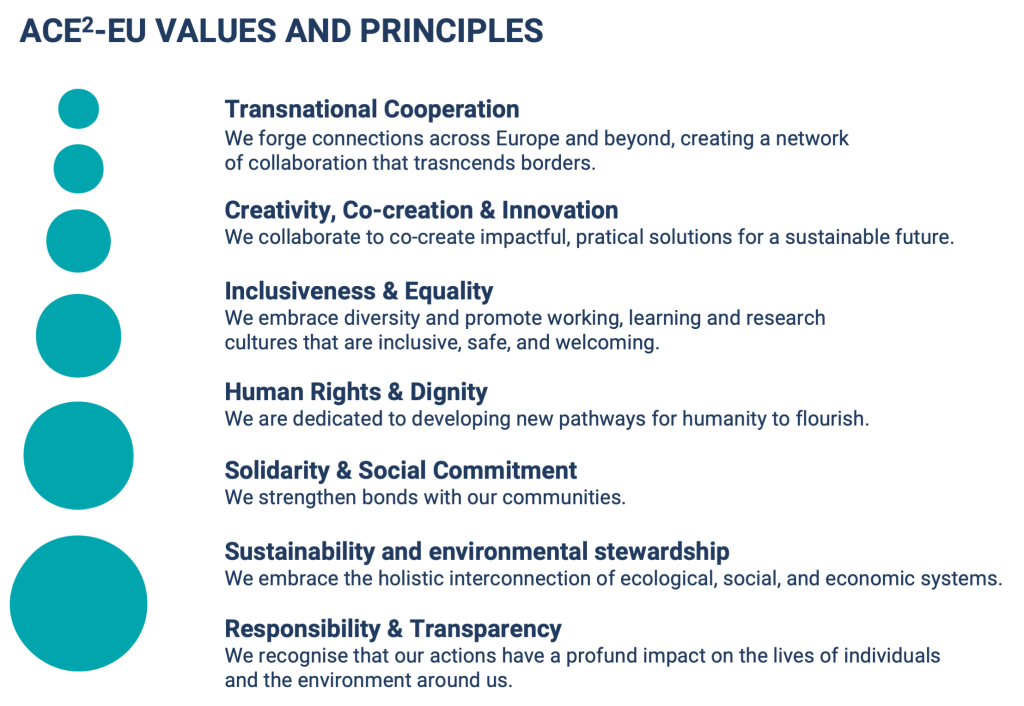
Values
vision and ambition
The principal aim of our common vision, ambition, and associated long-term joint strategy in the context of the European Universities Initiative and the European Universities strategy is to establish a European higher education inter-university campus which has the potential to transform the capacity and quality of institutional cooperation between ACE2-EU member institutions and bring it to the next level, fostering deeper integration, enhancing collaboration, and increasing our overall impact and influence within the European higher education landscape. Our inter-university campus will become a legally recognised European University with European and global reach, reputation, and impact focussed on “Addressing Future Challenges and Delivering Sustainable Societal Transformation Today”.
PRACTICAL GUIDE FOR INTERNATIONAL STUDENTS


Funded by the European Union. Views and opinions expressed are however those of the author(s) only and do not necessarily reflect those of the European Union or the European Education and Culture Executive Agency (EACEA). Neither the European Union nor EACEA can be held responsible for them. Project 101177596. The project is co-financed by the Ministry of Culture of the Republic of Latvia.