

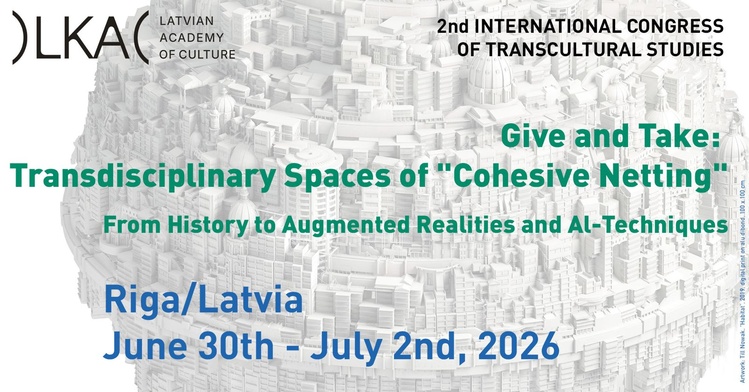
2nd International Congress of Transcultural Studies in Riga
The 2nd International Congress on Transcultural Studies will take place in Riga from June 30 to July 2, 2026. Coordinated as a joint project by three European universities—the Latvian Academy of Culture in Riga, the University of Macerata in Italy, and the KU Leuven in Belgium—this research initiative follows the 1st International Congress on Transcultural Studies held at the University of Macerata in 2025. This year, the congress focuses on the theme of Give and Take: Transdisciplinary Spaces of “Cohesive Netting”, ranging from concepts of Glocal History to Digitalization, Augmented Reality, and AI Techniques.
Inspired by the recent publication Die Welt als Gewebe (The World as a Web, 2025) by the German philosopher Wolfgang Welsch—who was most recently affiliated with the University of Jena and is known as the founder of the postmodern concept of transculturality—the congress aims to examine the “network euphoria” described by Welsch from both critical and innovation-oriented perspectives. With Wolfgang Welsch and around thirty other speakers in attendance—including scholars of Cultural, Literary, Film, Educational, and Music Studies, as well as art therapists, semioticians, and the German-American artist Till Nowak (who, among other works, created the environments for Francis Ford Coppola’s latest major film, Megalopolis, 2024)—the event will explore Welsch’s transcultural phenomenology. Methodologically focusing its application to the arts and the “network” metaphor introduced by Welsch in the early 1990s, the congress work intends to connect the latter to analog and digital conceptions of reality across diverse fields of art, culture, literature, and education.
Given the evident analogy between Welsch’s theoretical concept of network terminology and the global digitization of cultures, communication channels, and societies, the congress adopts Welsch’s approach—pinpointing artistic practice, the creative industries, and the evolution of Transcultural Studies in the digital age—with the aim of progressively expanding its parameters. The “web” formed by Transculturality, the Internet, and art offers diverse, novel transdisciplinary opportunities: for teacher training, didactic methods, and pedagogical approaches, as well as for the third spaces emerging from postmigration contexts—spaces constantly reconstituting themselves on both social and technical levels—and for melting pots shaped by post-colonial history.
On the threshold of a new era characterized by nomadic mobility, highly specialized media capabilities, shifting federalist structures, and transnational networks, the web-like—that is, cohesive—human paradigm described by Welsch must be recoded, or creatively interwoven and interlaced, to create a convivial and sustainable human future. By highlighting specific transcultural connecting lines and nodes, the congress seeks to examine the prism of transcultural networks from multiple perspectives—going beyond the level of Cultural Studies alone. Furthermore, the congress addresses the constructive sociological potential of a transcultural cosmopolitanism and the overarching goals of Global Citizenship Education within the framework of a contemporary “post-postmodern” Transculturalism defined by collective Give-and-Take, as reflected in the conference title. The conference language in Riga is English. A publication is planned for the digital platform of the academic journal Transculturale.
The first day of the conference, 30 June, will take place at the Latvian Academy of Culture's Theatre House "Zirgu Pasts" (46 Dzirnavu Street, Riga) from 15:00 to 19:00. The remaining two conference days, 1 and 2 July, will be held at the Radisson Blu Latvija Conference Hotel (55 Elizabetes Street, Riga) from 09:30 to 17:00. Admission is free of charge with prior registration: https://forms.gle/R9kwoYefEgBNsDxX9. Programme here - https://drive.google.com/file/d/1sQM0fb41pKipXMrgOg9m_ObqNUaWufXH/view?usp=sharing