

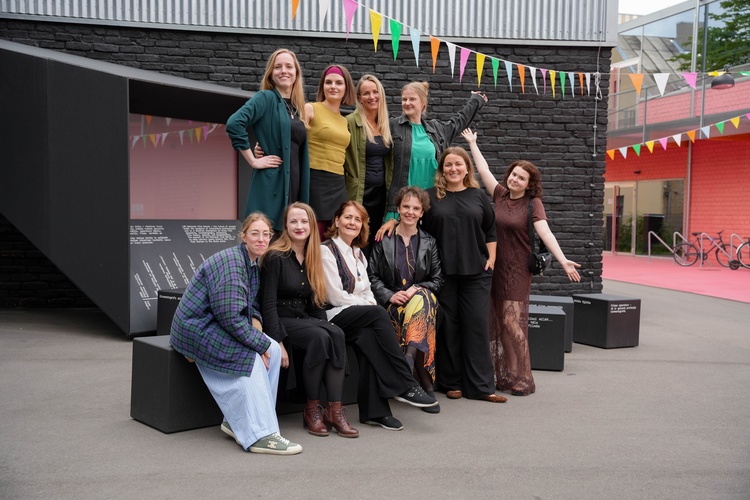
Cultural and Arts Management Students Address Key Issues in the Cultural Sector Through Their Master’s Theses
On 5 June 2026, ten students of the academic Master’s study programme “Cultural and Arts Management” at the Latvian Academy of Culture (LAC) defended their final theses. This year’s master’s theses stand out for their thematic diversity, ranging from cultural participation and well-being to personal branding, diplomacy, and community identity. The theses also demonstrate how closely cultural processes are connected to contemporary societal development and change.
Several master’s theses focused on questions of cultural participation and social impact, highlighting the potential of culture to strengthen well-being, foster integration, and create a sense of belonging within communities. In her thesis “Cultural Participation as an Instrument for Immigrant Integration: The Case of Choral Singing”, Elza Stalidzēna analysed how participation in choir movements contributes to a sense of belonging and social integration. Meanwhile, in her thesis “Cultural Participation as a Tool for Enhancing Well-Being: The Case of Latvian Folk Dance Groups”, Eva Liepa examined the experiences of Latvian folk dance groups and their impact on participants’ social, psychological, and emotional well-being.
This year, students also addressed issues of cultural accessibility and participation, highlighting opportunities for different social groups to engage fully in cultural processes and benefit from cultural offerings. In her thesis “The Operation of Amateur Theatres and Accessibility for People with Mobility Impairments in Cultural Institutions: The Case of Municipal Cultural Centres in Cēsis Municipality”, Indra Ramāne explored how accessible cultural life truly is for people with mobility impairments by analysing barriers and opportunities for their participation in amateur theatre activities and cultural events. At the same time, increasing attention is being paid to student well-being within cultural education. Jana Orlova addressed this topic in her thesis “Well-being practises in cultural education: The perspective of Latvian audiovisual art students”, analysing the impact of study workload, financial challenges, and emotional health on students’ educational experiences.
The students also explored communication strategies in cultural organisations and personal branding practices within the creative industries, highlighting the growing importance of communication in the work of cultural organisations. In her thesis “Surprise as an Attention Management Technique in Cultural Organisation Communication”, Ināra Zēmane examined how surprise can function as a tool for managing attention in conditions of information overload. Meanwhile, in her thesis “Erotic Capital as a Dimension of Personal Branding in the Creative Industries: The Case of Latvian Authors of Erotic Literature”, Annija Libermane explored professional communication and self-representation practices among Latvian authors of erotic literature.
Questions of cultural identity and representation were examined both in the context of local communities and cultural heritage preservation, as well as in relation to nation branding and the representation of national identity. In her thesis “The Role of Popular Culture in Representing a Nation’s Image: A Case Study of the Latvian Public Service Media Song Contest ‘Supernova’”, Kristiāna Štāla concluded that both the Eurovision Song Contest and Latvia’s national selection contest Supernova serve as significant platforms for public diplomacy and nation branding. Meanwhile, in her thesis “Community Participation Practices in Creating Authentic Experiences in Cultural Tourism: The Case of the Malēnieši Community”, Daiga Lejiņa highlighted the role of local communities in the development of cultural tourism and the preservation of cultural heritage.
Museum and contemporary art processes were explored by Beata Vrevska and Kristiāna Šuksta, both addressing how cultural organisations and artistic practices are increasingly moving towards dialogue with audiences, participation, and the co-creation of experiences. In her thesis “The role and responsibility of the curator in audience-centered museum and exhibition practice”, Beata Vrevska investigated the changing role of the curator in contemporary museum work, concluding that alongside traditional functions, increasing importance is being placed on shaping audience experiences and fostering dialogue between cultural institutions and society. Meanwhile, in her thesis “Curatorial techniques in the implementation of works of art based on relational aesthetics”, Kristiāna Šuksta explored how different curatorial methods contribute to the creation of artworks based on participation, interaction, and social relations.
The theses will be available for consultation at the LAC Library (24 Ludzas Street) and online in the digital repository: https://dspace.lka.edu.lv/.
Information prepared by
Aija Lūse
Director of the Master’s Study Programme Cultural and Arts Management