

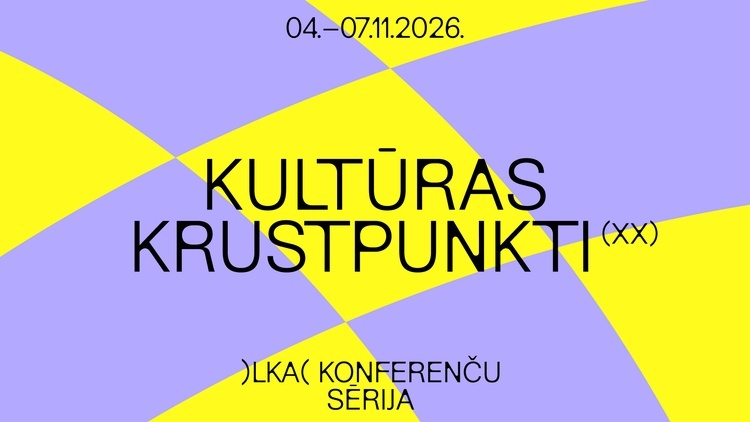
Call for Papers: Conference Series 'Cultural Crossroads XX'
The Latvian Academy of Culture announces a call for papers for the conference series “Cultural Crossroads XX”, celebrating its 20th anniversary this year from November 4 to 7. Researchers, students, cultural practitioners, and anyone interested in the research of cultural and artistic phenomena are invited to become co-creators of the conference and submit their abstract for one of the thematic sections by October 11.
In an era of major transformations, it is particularly important for cultural and artistic organizations, citizens, and communities to develop strategies and action models on how to use the shield of culture to protect public resilience and sustainability. Today's security and democracy threats necessitate a special focus on processes that develop and protect cultural values, support artists, and strengthen citizens' right to culture. Therefore, the main challenge for cultural and artistic research in the coming years is to explain how cultural practice and artistic creativity shape individual and collective values.
The conference series “Cultural Crossroads XX” will take place over four days. The cycle of events will open on November 4 with the conference plenary session, on November 5 and 6 researchers and industry professionals will gather to work in thematic sections, while a wider range of events is expected through November 7, including the Baltic Drama Forum conference events. Further information about the program and additional events will follow soon.
Anyone interested in researching cultural and artistic phenomena is invited to submit their research and register for participation in the thematic sections of the conference by October 11 of this year by filling out the online application form.

The work of the conference will take place in 7 sections:
PERFORMING AND AUDIOVISUAL ARTS
Moderators: Līga Ulberte and Daniela Zacmane
Practitioners and researchers of Latvian performing and audiovisual arts are invited to apply to this section to share reflections, experience, and research on current issues in these fields.
We invite special attention to:
– the close links and interaction between cinema and theatre in the Latvian cultural space,
– the latest Latvian films and performing arts works.
CULTURE AND ART, CITIZENS, COMMUNITIES, AND SOCIETY
Moderators:Ance Kristāla, Iveta Ķešāne
We invite researchers from various fields of humanities, arts, and social sciences (cultural sociologists, art sociologists, anthropologists, art historians, etc.) to present their research related to the interaction processes between culture and society in times of digital transformation and security threats. Alongside traditional questions about cultural processes and artistic creativity, we expect conference participants to pay increasing attention to digitalization, artificial intelligence, transformations of social inequality, contexts of security threats, and ecological sustainability; as well as the changing relationships between cultural institutions and society determined by these factors.
Possible range of topics:
– Participation in culture, inequality and social inclusion, intergenerational interaction;
– Cultural audience, art perception, and art literacy;
– Cultural events, artistic creativity, art, and social activism;
– Transformation of creative professions and employment insecurity;
– Cultural identity and collective memory;
– Cultural and art institutions, governance, and cultural democracy;
– Research methods in culture and arts, artistic research, and impact assessment research.
Submissions on interdisciplinary topics touching upon sociology of culture and art, cultural management and production, cultural policy, economics of culture, cultural education, and other related issues are also welcome.
Researchers, doctoral students, master's students, and other students representing humanities, arts, and social sciences, as well as interdisciplinary research, alongside practitioners in the cultural and creative sectors are invited to participate in this section.
TRANSFORMATIONS AND DEVELOPMENT PROCESSES IN CULTURAL AND CREATIVE INDUSTRIES
Moderators: Elizabete Palasiosa and Ieva Zemīte
The section focuses on the development, change processes, and future perspectives of cultural and creative industries, analyzing them in social, economic, and technological contexts.
Possible range of topics:
– development and transformation of cultural and creative industries, including industry trends, creative industry ecosystems, new operating and collaboration models, cross-sectoral and interdisciplinary cooperation;
– digitalization and the impact of technology, including digital transformation, artificial intelligence, augmented reality, and other new technologies, creation, distribution, and consumption of digital cultural content, impact of technology on creative work;
– cultural and creative entrepreneurship, including business models, innovation, development of new products and services, financing, and value creation models;
– sustainability and green transformation in cultural and creative industries, including environmental sustainability, social responsibility, circular economy principles, and development of sustainable cultural and creative practices;
– cultural marketing, audiences, and participation, including audience development, changes in cultural consumption habits, communication, digital marketing, community engagement, and forms of participation;
We invite researchers from various fields to present research on development trends, transformation processes, and future prospects of cultural and creative industries, as well as changes in cultural entrepreneurship, cultural and art management, creative work, and operation of cultural organizations. We particularly encourage studies analyzing cultural and creative industries in the broader context of social, technological, economic, and environmental changes, as well as addressing the interaction between culture, technology, entrepreneurship, and other areas of the economy and society.
Researchers in humanities and social sciences, as well as interdisciplinary fields, doctoral and master's students, researchers and practitioners in cultural and creative industries, heads of cultural organizations, and other industry professionals are invited to participate.
CULTURAL HERITAGE
Moderators: Lolita Ozoliņa, Ieva Vītola, Juris Urtāns
Main section topic: Cultural Heritage: Risks of Threat and Governance Practices
Researchers from various disciplines are invited to share experience on current research in cultural heritage, its preservation, and governance. Special attention will be paid to risks threatening cultural heritage values, as well as practices that help identify, mitigate, and manage these risks in changing social, political, and environmental conditions.
Possible range of topics:
– preservation of cultural heritage values in times of security threats;
– risks caused by climate change and preservation of cultural heritage;
– role of communities in cultural heritage preservation and governance;
– cultural heritage as a resource for community belonging and resilience;
– values of cultural heritage and commercialization processes;
– conflicts and compromises in cultural heritage preservation and utilization.
INTERCULTURAL RELATIONS STUDIES AND LANGUAGE USE IN CULTURE
Moderators: Anita Naciscione, Elīna Veinberga, Signe Bahšteina
Main section topic: Interaction of different cultures and languages, intercultural communication, linguistic diversity and creative language use, cultural identity and belonging, language as a resource for social, cultural, and digital interaction.
The section is dedicated to exploring the mutual interaction of cultures and languages in contemporary society, focusing on everyday communication, language creativity, media, mobility, and digital environment processes that influence culture through language.
We invite researchers and practitioners from various fields to share results of original research on issues of language and culture contact, its creative, social, applied, political, and other aspects. We also invite contributions exploring the challenges and opportunities of multilingualism, translation, migration, digitalization, and artificial intelligence in language use and intercultural communication.
Possible range of topics:
– cultural contact, intercultural communication, and intercultural dialogue;
– multilingualism and language use in various social and professional fields;
– language as cultural identity and belonging;
– language and culture contacts in the context of migration, mobility, or diaspora;
– language ideology, language prestige, and linguistic landscape;
– creative language use in translated literature, advertising, popular culture, and everyday communication;
– language in digital culture – social networks and digital communities, digital discourses, and AI language;
– intercultural communication in the workplace, tourism, diplomacy, and other applied fields;
– language and culture under conditions of security threats, crises, and rapid social change;
– language in interdisciplinary research related to linguistics, communication science, translation studies, media studies, and other fields.
Working languages of the section: English and Latvian.
ART, LITERATURE, AND VISUALITY
Moderators: Zane Grigoroviča, Raimonds Briedis
Main section topic: Text, Image, and Space: Literature, Art, and Subcultures in the City
We will pay special attention to how text becomes a visual sign, image becomes a narrative form, and urban space becomes a medium in which cultural narratives are created, read, and interpreted.
We encourage discussions on how alternative identities, communities, and aesthetics form in urban environments, as well as the role of subcultures in shaping the city's visual and textual landscape.
Possible range of topics:
– Text in urban space: inscriptions, posters, playbills, graffiti, signs, typography, and other textual elements as part of urban visuality;
– From text to image and from image to text: mutual interpretations of literature, visual arts, and other media;
– Textuality and visuality of subcultures: fanzines, music scenes, street culture, graffiti, poster culture, fashion aesthetics, and digital communities;
– The city as text and image: reading, mapping, photographing, documenting, and transforming urban space;
– Poetics and visuality of urban experience: images of the city in literature, photography, cinema, illustration, and contemporary art;
– Alternative cities: spaces created by subcultures, unofficial cultural places, and their representations;
– Public space as a cultural medium: street art, performances, installations, interventions, and other spatial practices;
– Text as visual practice: experimental typography, visual poetry, artists' books, and text-objects;
– Digital urban culture: social networks, digital documentation, memes, digital graphics, and virtual subcultures;
– Urban memory and alternative narratives: individual and community stories, archives, photographs, oral history, and visual evidence.
We invite researchers, artists, writers, and cultural practitioners to focus on the city as a textual and visual environment where literature, art, architecture, subcultures, and various alternative cultural practices interact.
YOUTH RESEARCH
Moderator – Gints Klāsons
The section is dedicated to the study of youth, youth work, and the youth sector. We invite contributions examining young people's life experiences, opportunities, and choices, as well as the activities of professionals, organizations, and institutions involved in the youth field. The section will also focus on non-formal education processes and outcomes, the implementation of youth policy, and the application of research-generated knowledge to sector development. A specific focus will be placed on research approaches and methods that allow for exploring youth experiences and evaluating youth work practices.
Possible range of topics:
– youth values, identity, sense of belonging, and future aspirations;
– youth participation in society and culture, creative expressions, and self-organization;
– youth well-being, digital experience, education, employment, and transition to independent living;
– social and territorial inequality, inclusion, and access to opportunities for various youth groups;
– youth work approaches, forms, and content—their accessibility, quality, and impact;
– non-formal education and learning, acquired competences, their assessment and recognition;
– competences, professional identity, working conditions, and professional development of youth workers and other sector professionals;
– operation of youth organizations and institutions, sector resources, sustainability, and cross-sectoral collaboration;
– youth policy development, implementation, and evaluation, use of data and research in decision-making;
– research methods for youth and the youth sector: quantitative, qualitative, and mixed methods, participatory research and youth engagement, research ethics, and impact assessment approaches.
Researchers from various disciplines, doctoral, master's, and other students, youth policymakers, youth workers, non-formal education providers, and representatives of youth organizations are invited to participate in this section. Results of academic and applied research, practice-based evaluations, as well as methodological proposals that stimulate discussion on research opportunities and needs regarding youth and the youth sector are welcome.
This year, the program of "Cultural Crossroads" will also be complemented by the Baltic Drama Forum (BDF) conference (November 5–7), organized by the Association of Latvian Theatre Workers in collaboration with the Jāzeps Vītols Latvian Academy of Music and the Latvian Academy of Culture. It will be dedicated to the development of artistic research and challenges of academic work in the Baltics and worldwide.
The LKA annual conference series "Cultural Crossroads", in its twentieth edition, has become an important and anticipated event in the sector. Its multidisciplinary program connects experienced and emerging researchers, students, and cultural sector practitioners every year. The aim of the conference is to create an open environment for discussing research results, as well as to encourage academic discussion on the role, values, and social responsibility of culture and art in the context of contemporary political, economic, and social changes.