

From Audience Insights to Marketing Concepts: LAC Master’s Students Develop Ideas for the Museum of Literature and Music
How can a museum become not only visible in the digital environment but also personally meaningful to different audiences? How can communication move beyond simply providing information and inspire people to engage, participate, and return? These were the questions explored by first-year students of the Master’s programme “Cultural and Arts Management” at the Latvian Academy of Culture during the course “Cultural and Digital Marketing”, in collaboration with the Latvian National Museum of Literature and Music.
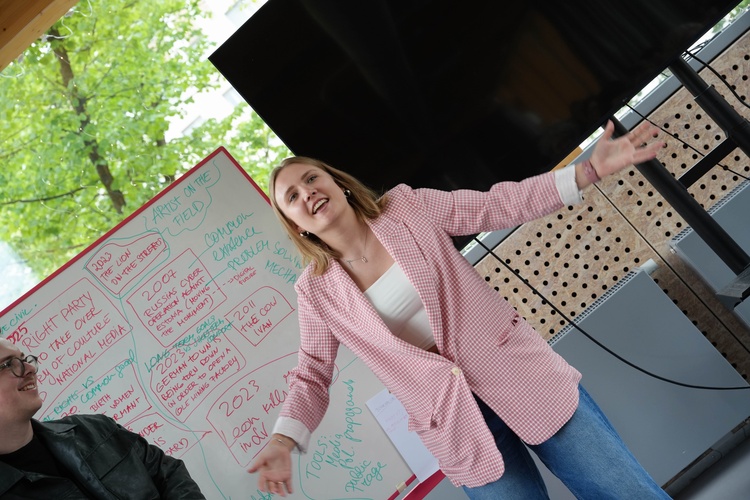
As a final assignment, student teams were tasked with developing digital marketing concepts for audience segments that remain underrepresented in the museum’s current communication efforts. Each team analysed a specific target audience, identified its needs and communication barriers, and designed a digital campaign concept, content strategy, and engagement mechanisms. The task required not only creativity, but also strategic thinking and practical applicability.
At the centre of the project was the museum’s exhibition “Procrastination and Creation”, which served as a starting point for analysing audience motivations, behavioural patterns, and digital habits.
One team focused on international visitors. Their research showed that the museum remains relatively unknown to foreign audiences and is often perceived as too locally oriented or specialised. In response, the students developed the campaign concept “We All Do It”, which presents procrastination as a universal human experience. Rather than positioning the museum solely as a guardian of Latvian cultural heritage, the campaign uses humour and self-irony to frame it as a place where visitors can recognise themselves in the experiences of world-famous writers and composers.
Another team worked with cultural professionals – an audience that engages with cultural processes on a daily basis but does not always find time to become active cultural consumers themselves. The students identified a key communication challenge: professionals often do not perceive the exhibition as something directly relevant to their own experiences. To address this, they developed the campaign “Latvians Are Not Afraid of Procrastination”, centered around reflection on creative processes, interviews with writers, professional testimonials, and collaborations with industry media, organisations, and communities. The campaign envisions the museum as a space for professional dialogue, self-reflection, and exchange of experiences.
A more emotional approach was chosen by the team focusing on families. Their campaign, “Let’s Grow in the Museum!”, is based on the idea that a museum visit is not merely a cultural activity but an opportunity to spend meaningful time together. The students highlighted that parents seek not only educational experiences for their children but also opportunities for shared experiences. Therefore, the campaign emphasises family togetherness, children’s curiosity, and taking a conscious pause from everyday routines. Its central message – “Postpone your tasks. Don’t postpone your loved ones.” – connects naturally with the exhibition’s theme while extending its relevance to family life.
Equally compelling was the concept developed for senior audiences. Drawing on research and audience surveys, the students concluded that the main barriers are not only digital literacy or mobility limitations but also social isolation and the tendency to postpone cultural experiences. As a result, they created the campaign “Don’t Postpone Culture!”, which aims not to explain procrastination as a concept but to engage seniors on a personal and emotional level through the stories of writers and composers. The campaign is designed in cooperation with Latvian Radio, regional media, and community organisations, combining digital communication with in-person activities.
The collaboration with the Latvian National Museum of Literature and Music provided students with an opportunity to work on a real-world challenge faced by a cultural organisation, while offering the museum fresh perspectives and new ideas for engaging diverse audiences in the digital environment.
The Latvian Academy of Culture extends its gratitude to the students for their work and to the museum for its collaboration.
Prepared by
Aija Lūse
Director of the Master’s Programme “Cultural and Arts Management” Latvian Academy of Culture